
Shell advertised its motor oil as “climate neutral”, backing the claim with purchased carbon credits from reforestation projects. The Hamburg Regional Court ruled that a fossil product cannot be climate neutral per se, no matter how many certificates stand behind it. Beiersdorf also faced criticism when it advertised its NIVEA shower gel as “climate-neutralised”, a self-invented term that is reminiscent of “climate neutral” but follows no uniform definition.
Both examples show that even large corporations with their own legal departments can stumble when it comes to environmental communication. For mid-sized companies, which usually cannot afford such compliance structures, it is therefore worth taking a closer look at the topic, because since 27 September 2026 statements of this kind can become a concrete legal risk.
What changes with EmpCo
The EU directive “Empowering Consumers for the Green Transition” (EmpCo, EU 2024/825) becomes binding in Germany through an amendment to the Act against Unfair Competition (UWG). Among other things, it prohibits generic environmental claims such as “environmentally friendly” without proof of recognised environmental performance, product-related advertising of climate neutrality based on offsetting, which is exactly the Shell pattern, advertising of future environmental performance without a verified implementation plan, and sustainability labels without a genuine certification scheme.
There is no transition period and no sell-off period, so the rules also apply to existing stock. Initially affected are companies that communicate directly with consumers, i.e. everything relating to packaging, website, advertising and social media. Violations can lead to injunctions and claims for damages and, where there is an EU-wide dimension, to fines of up to four per cent of annual turnover.
Procurement is affected too
This also applies indirectly to procurement. Formally, EmpCo only covers communication with consumers, so pure B2B companies are not directly within its scope. Nevertheless, the directive changes what business customers expect from their suppliers: anyone who advertises to consumers must be able to substantiate their claims and will increasingly demand this evidence from their suppliers. Procurement is therefore challenged twice over: it must be able to provide evidence to its own customers and, in turn, request it from its own suppliers, even without any direct consumer business. In addition, as soon as consumers see content on a website, social media or careers page, EmpCo applies there as well.
The real problem is volume
Shell and Nivea attracted attention because their claims were discussed publicly. A mid-sized company rarely gets that kind of attention, but it often has hundreds of product pages, flyers and packaging texts that have grown over the years and have never been systematically reviewed. This is how wording that was chosen without much thought keeps running unnoticed, and at this scale a manual case-by-case review is hardly affordable.
A pragmatic path to compliance
The path to EmpCo compliance begins with raising awareness among the people acting within the company, followed by a review of existing claims and, in difficult cases, a legal assessment, followed by adjustments and by embedding this process in the company.
The most time-consuming and at the same time most important step is the review of existing claims. For this purpose, we at ESTURION, together with experts in big data and compliance, have developed a systematic review process for environmental claims that is even used by TÜV.
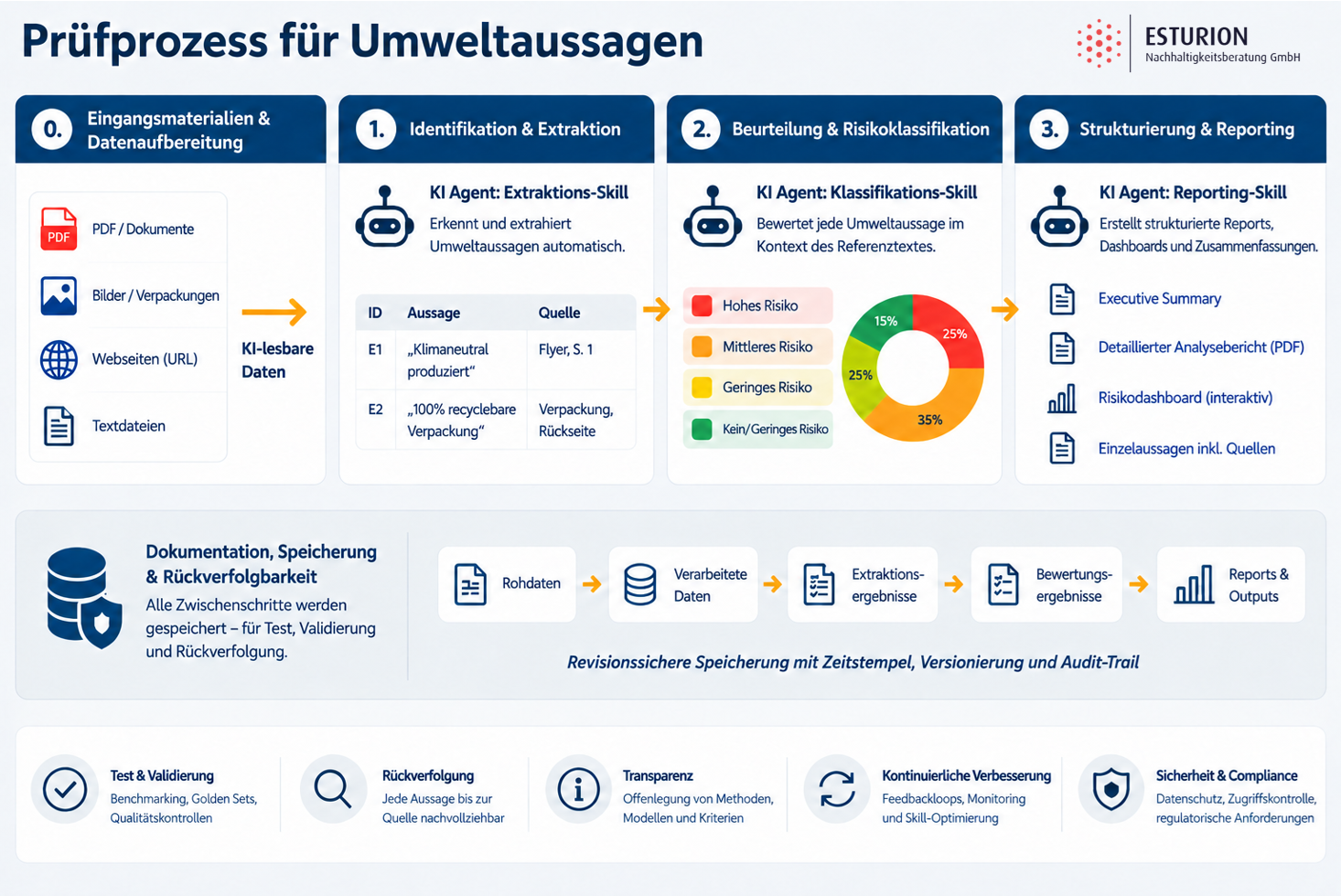
The process is divided into four stages. In stage 0, all available materials such as PDFs, images, packaging photos and websites are converted into machine-readable data. In stage 1, an AI agent automatically identifies environmental claims such as “produced climate-neutrally” and records exactly where they appear. In stage 2, a second AI agent assesses each claim in context and assigns it to a risk class ranging from high through medium and low to no risk. In stage 3, a third agent summarises the results as an executive summary, a detailed analysis report and an interactive dashboard listing every single claim together with its source.
Auditable AI for audit-proof results
What happens in parallel with these analysis steps is decisive. Every intermediate step is stored in an audit-proof manner with a timestamp and versioning. True to the motto “an AI that checks must itself be checkable”, every claim can be traced back to its source. The methods used are disclosed within the company, and the hit rate is continuously measured against test cases.
This creates a working basis on which every classification can be understood later on. Management can assess for itself what is urgent, what is borderline and what is uncritical. Uncritical cases can be adjusted directly in-house. For borderline cases, it is advisable to involve a lawyer specialising in competition law, for whom the report then serves as a working basis, without duplicated effort.
Conclusion
EmpCo shifts the burden of proof: anyone who advertises with sustainability in future must be able to back it up, and not only when asked. For mid-sized companies, this means above all reviewing their own communication and, in procurement, that of their suppliers in good time and in full. Technology can help to solve the volume problem, while assessing the results remains a business and legal task.
Learn more about our offering: ComplianceReady with a focus on EmpCo
This article was first published in German in the procurement magazine “Kleine Kniffe”.